60%
Faster environment switching
Reduced from 1:23 → 0:33 through platform-aware switching and clearer context cues.

Establishing shared platform foundations for identity, access, and environment management. Reducing cross-platform friction and accelerating environment switching by 60%.

Define the shared platform foundations needed to unify Coates’ ecosystem and reduce cross-platform friction at scale.
As Coates’ ecosystem expanded, users were managing increasing platform complexity themselves juggling environments, access, roles and disconnected workflows. Without shared foundations, each new tool or market introduced additional friction and risk. This initiative shifted that burden from users to the platform, creating a scalable, predictable experience that supports both internal teams and future customer-facing growth.
This reframing aligned stakeholders on the idea that fragmentation was a platform problem, not a product-level issue.
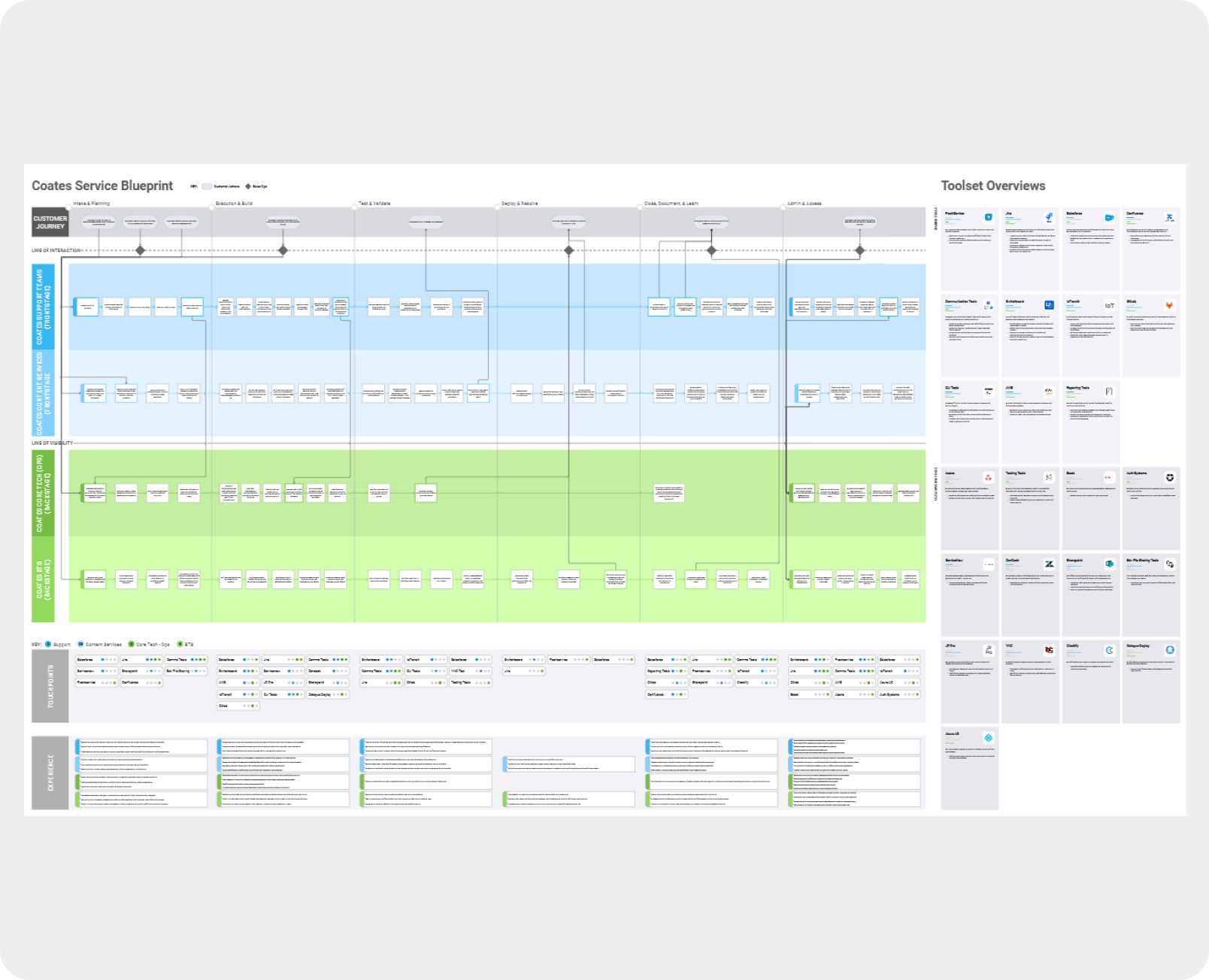
This resulted in a service blueprint that mapped the end-to-end journey across front-stage and back-stage operations, connecting Content Services, Coates Support, BTS, and Core Tech. The blueprint defined six key stages of the experience:
Across these stages, it surfaced:
This work made fragmentation visible at a system level, highlighting where users were bridging gaps between tools and processes. It directly informed where platform-level intervention was required — shaping the role of the management layer in unifying access, environment context, and workflow continuity across the ecosystem.
The initial direction explored a global environment switcher, where a single control would update context across all tools. While this aligned with familiar mental models, it introduced a critical risk: not all platforms share the same environment structure.
Applying a global switch would have created false assumptions about shared state, increasing the likelihood of users operating in the wrong context.
The direction shifted to a platform-based environment model, where environment switching is scoped only to systems that rely on it. This prioritised accuracy and predictability over forced consistency.
This decision reduced risk, improved user trust, and ensured the interaction model aligned with real system behaviour.
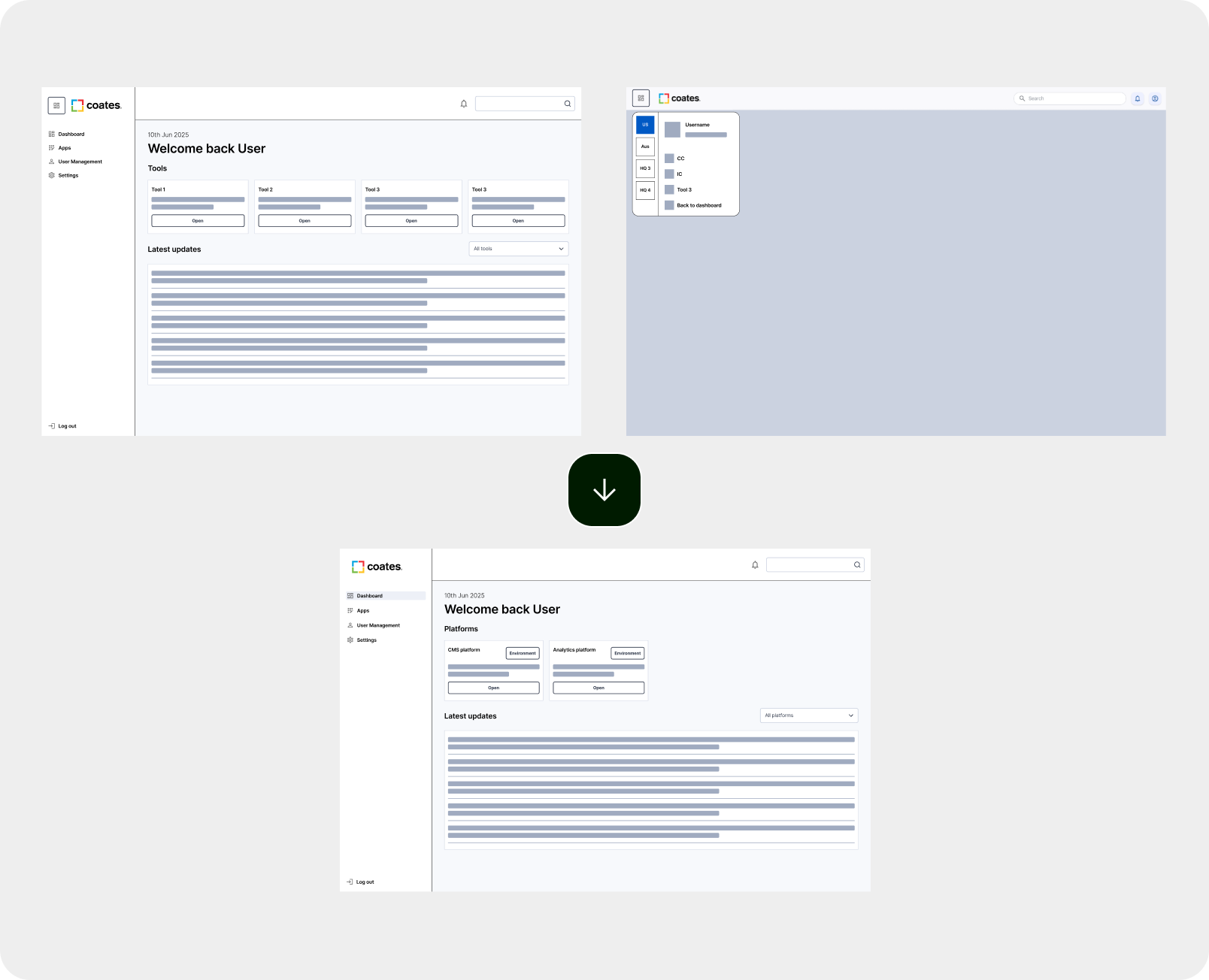
The work focused on high-impact entry points like the front door, navigation, and access management to show platform cohesion.
This helped stakeholders visualize the platform’s direction while remaining scalable and ready for integration.
Balancing strategic alignment with the practicality of building on existing systems helped avoid design debt.
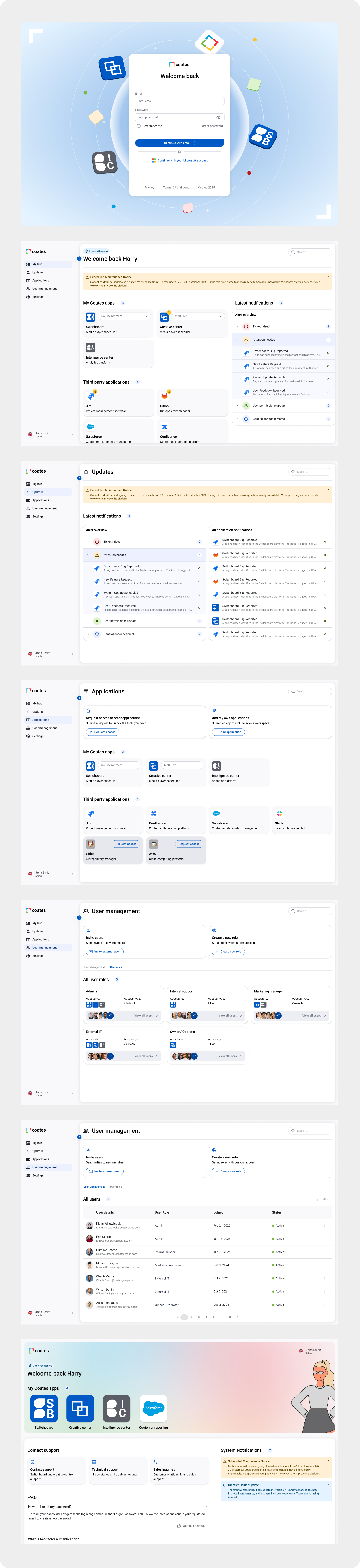
Rather than defining a single feature, it introduced shared patterns for identity, access, environment context, and navigation — creating a reference point for how Coates platforms should behave as a unified system.
This work shifted platform design from isolated product decisions to shared system behaviour, enabling Coates to scale its ecosystem with greater consistency, safety, and efficiency.